About me

My photo
I began this blog in order to share my experiences learning instrument building from my dad, but along with those stories I look forward to sharing my memories of growing up with two busy, musically inclined parents as well as my current experiences stepping out on my own as a female luthier promoting environmental sustainability in her instruments while working to alter gender stereotypes in a male dominated field. If you'd like to use quotes from this blog for interviews or in your own work, please contact me first! (email is henderson.elizabethj@gmail.com)

Friday, May 20, 2016

Scrapes and Scratches

Can't wait to finish up this tenor uke! 
One thing about working half the time in Rubgy is that there is another part of my time spent at home in Asheville typically performing the less physically demanding aspects of my job. I do have a little sander and I do still occasionally cut myself or file my fingernails when I am doing inlay work but generally I focus on the business side rather than the actual guitar and ukulele making. The thing I like about this set up is that it leaves room to wear open toed shoes, put on a dress, primp, and paint my nails. Though sometimes the nail polish is also functional. Not in the way that I make up when my dad protests as he sees it and I tell him that it makes my fingers easier to see so I keep them out of the table saw, which he appreciates, but to camouflage black super glue and stubborn stain stuck underneath. In the case of this week it is covering a now very sensitive flat spot made by the sander. When I look at it though I don't see pain or frustration, but I do see a beautiful ukulele that I thought needed a straighter neck angle so I sat the whole thing on the sander. Just like the time I sanded almost through the top of one fingernail when I let a neck slip as I shaped its heel, I will probably think twice before sitting my ukulele on the coarse grit sander.

I get an odd pleasure from bringing home little scrapes and scratches on my body. I typically walk in my door with marks on my arms from carrying wood planks around, or a sanded fingernail or two that needs evening up with clippers, or this particular time, a thick scab on by leg from when I moved a pattern and a hefty plank of maple I hadn't noticed leaning agains it tipped in my direction and accosted my shin bone. These minor afflictions to my body serve as evidence that I have done done something useful with my time and I like that.

Of course, I hope never to procure a lasting injury any more serious than the tiny scar on my right middle finger from when it came into the line of fire of my hand powered, millimeter-wide jeweler's saw blade. I do make absolutely sure to keep my hands free from direct contact with any motorized saws. I wish I could still ask my dad to make the cuts I need on the table saw or slice me a set from a large board of walnut with the re-saw, but I am proud that I can now do it myself. I do however respect the saws and quite literally each time before I turn any of them on I take a minute to be thankful for the use of my fingers and consider what would happen if one or two got tangled up in the blade. Before I push that green button to bring the machine roaring to life I find the orange safety handle gathering dust on the shelf, as I am the only who uses it, to ensure that my hands are always far from the moving blade. I also find it important to consider where my hands will be in correlation to the blade as I push the wood through. Anyway that is just a side rant. My point is simply to respect the machinery and be careful of the big saws!

Now that I have been working on my own without feeling the need to ask my dad to help with the big saw cuts it really makes me happy to be able to be helpful to him for a change. He gives so much of his time so freely. Not just to me, but he stops what he is doing and provides his full attention any time a visitor stops in or when the phone rings, which it does almost constantly throughout the day. For some reason or another, he has agreed to make ten guitars before his festival next month. Some for payment to the bands coming to play, one for a raffle to be held on the day of the festival and some for folks traveling from far distances that, last winter when the task wasn't imminent, he agreed to finish in time for their visit to Rugby.

My dad always says that he asks me to do his inlay work because he has done it long enough that he is tired of it and I am still young and eager so he asks me. I am pretty sure, though, that his least favorite part of the job is finish work. The way we finish our guitars is to spray seven or eight layers of catalyzed varnish onto the bodies and necks and sand them flat between each coat. The work is time consuming, dusty, loud, and smelly so I can understand why he'd prefer not to have to do it. Lucky for him, on top of the inlay I feel privileged to get to cut for his instruments, I don't mind finish work and was more than happy to be asked to help get these guitars done in time. I just tied on my purple apron, strapped on my respirator mask, slipped on my ear protection and got to it. Not the most glamorous job but I do have pink filters on my mask.

So many guitars to finish, so little time! 
After finishing my own guitar that I am delivering to the Canary Islands later today, I sprayed and sanded all of the finish on three of his guitars and added layers to the ones he had sprayed. It feels really nice to feel useful and to be able to give him something after so many years of only being able to take. We also spent the majority of last week in the shop alone. Few visitors, other than Tuesdays, no gigs to go play, just time to focus on a common goal and be able to have that elusive relationship that I have wished for for years, where my presence is needed rather than tolerated. It isn't just that I want him to give me something but that I get to give too. So perhaps that is why those little nicks and scrapes are important to me. There is evidence that I hung out with my dad and we both enjoyed it.

# 36, Black walnut
I mentioned going to Spain later today. As the culmination of my time at home my husband and I are headed out to the Canary Islands to deliver the Black walnut OM-28 I just finished. I am not sure why, but the ones that go the farthest are the ones that sound the best. I wish I could keep this one to show what a local wood guitar can sound like because the wood that makes up this guitar absolutely couldn't wait to become a musical instrument. It might also have something to do with the fact that I did this one completely on my own, no checking, no trading inlay for a neck set, no direction other than my own judgement and my own decisions. I do want to share that as I (carefully) ran the neck through the table saw to cut the dovetail, never has one come out so cleanly that it fit into the body exactly how I wanted it to. Other than when I cut the dovetail for Doc's guitar, for which I had help, I have never achieved such a feat. I typically have to measure, rasp, sand, whittle, and measure some more to get the joint to fit how it is supposed to. Anyway I just wanted you to know that because it felt like a week where I saw progress, which I feel is something to stop and appreciate. Like when you practice a new skill and it is horribly difficult for the first long while and you don't see much change and it doesn't feel like anything is happening but one day you can just do it? That is what this felt like. I know it won't be a regular occurrence, but I am so thankful it happened this time.

So off we go to Spain! I will see you in a week and can't wait to tell you about our trip. My nails are painted (not just to cover up that flat spot), the ugly dark scab has finally detached itself from my shin so I am ready to wear dresses. I can't wait to get back into the shop and make more evidence that I have a job I absolutely love, but for now, vacation.

It's always good to make sure you have a good tester around.


Saturday, May 7, 2016

The General Store

Ok, so I had no idea it had been so long since I had written you a story. None at all. I thought I had missed maybe 2 or 3, but not this long. I apologize for that and will do my best to keep up better. It is a busy time when what feels like one month is actually three. Woops.

I am on a roll. My guitar body is glued together, I am halfway through securing binding onto its sides. While I pull strips of tape from the industrial dispenser, nicking my knuckles on its angry serrated edge in the process, I am planning what I need to do next. Around 11:45am, my dad walks into the shop and says, "I want some breakfast. Want to go to Sarah's?" I check the time and while I have been working for several hours, my breakfast having been consumed at breakfast time, I say yes. I stop what I am working on and go.

I used to say no thanks when my dad asked me to accompany him to get breakfast at his favorite local general store because I didn't want to eat at that odd time between breakfast and lunch. I now understand he goes for so much more than just breakfast. Fox Creek Trading Post has been in operation for generations and one of the things I love about it is that, like Rugby itself, not much has changed. The shelves lining the walls that reach all the way to the ceiling are still piled with goods, clothing, and toys. I found a doll dressed as a nun, some dusty cigar boxes on a top shelf and a sign advertising shoe polish among the dishes, aprons and canned goods lining the dining area in the back of the store. Sarah Teitelbaum runs the old store and while she isn't originally from here, which is typically comparable to sporting a scarlet A in the eyes of locals, she has made herself a spot in the history of this tiny pocket of VA. It doesn't hurt that she's "good lookin'" (my dad says) and that she treats everyone who comes through her door as though they are the most important person in the county, but she has created a gathering place where folks can congregate and hear the scuttlebutt. I love that like generations before us, we still crave that sense of community and we are still fiercely protective of it.


Cigar boxes on the shelves of Fox Creek Trading Post
I remember when I was young Vivian Osborne ran the local store. My Great Uncle Cone, a man who had one of the most wrinkled faces I had ever seen, would sit quietly by the window closest to the wood stove and smoke most of the day away. He and his cronies would gather in the back of the store every morning for coffee and then the guys with jobs would leave only to return as soon as they were finished for a game of Rook or checkers. "My dad used to love to come in here. Every day after he got the farming and drove the school bus, he would come in here and play cards with his friends," my dad told me once. I remember being somewhat frightened of the posse of old men, thinking that their dealings were secret and probably important so I best keep my distance.

Old and new.
When my dad and I walked in to Vivian's, he would ceremoniously present me with one dollar to spend in the store. While he opened his wallet he would always tell me how he had never seen a dollar at my age and then would proceed to point out all the things he could have purchased with a dime. I always wanted a scratch off lottery ticket and my dad would make a big show of saying I was too young and there was no way Vivian would sell me one. While my dad chatted with his neighbors, I would tentatively approach the counter, which obscured my view of what was hidden behind it as it rose to exactly my eye level. The scratched laminated pad sitting atop the counter advertising the tobacco products offered, yellowed with age, curled up at the edges closes to me. Vivian would wait patiently for me to make ask her for a lottery ticket. Eventually I would and she would allow me to choose which one I wanted, usually the most colorful one. I would walk away ecstatic, as though I had gotten away with something, though in hindsight, she probably had a standing arrangement with my dad. He would give me a penny to scratch with, but I never used it, opting for my fingernail instead. It was so much more satisfying, scratching that shiny later away to reveal the prize underneath.

When my dad was young Vivian's husband Van Osborne ran the store. He said it was just the same as when I was growing up, the old men sitting around playing checkers and cards, discussing things like price you could get for tobacco and how high the price for chicken feed had risen. Last night when my dad and I sat by ourselves in his shop I asked him what he remembered about the store when he was  young. He said, "When I was young you couldn't go anywhere else but the store because driving to town was reserved for special occasions. You could get whatever you needed there. People would even come in and ask for haircuts. Van would gesture to the barber chair he had sitting in the back room and he would cut their hair. Once a man named Brack Davis, probably some kin to us, walked in and pointed to his tooth. Didn't say anything, not that I heard anyway. Van gestured to the barber chair and Brack walked over and sat down. Van took a pair of pliers and yanked that tooth out! You never saw so much blood. Brack spit a few times into the coal bucket, said thank you to Van, settled up, and left. That was when that store was in the building where my old shop used to be. Another thing folks used to do was have shooting matches. They would get a circle of cardboard and draw lines facing out like spokes on a wheel and attach it to the wall with a nail. Everyone would write their names on the wheel and then someone would spin it so fast the names would blur. Then someone would shoot at the spinning wheel and whoever's name it hit got the pot. Uncle Cone told me that during wartime when there weren't any bullets to shoot and the guys still wanted to play that game, they would do it with a knife. There's a big ol' hole where the knife blade would hit the wall. It is still there in the wall of my old shop."

Sarah needed a table for her coffee pot,
my dad went home and made her one
We pass a few other little stores on the way out to Sarah's. I think the reason for that is because she not only appreciates that sense of community, she builds and nurtures it. She doesn't mind that a fellow with nothing better to do comes in every morning and sits by the counter all day buying nothing but coffee. She is happy to oblige all of our requests from breakfast at noon to a sandwich on her menu that, without prompting, she always remembers exactly how I like it. Guys come in on their lunch break and she offers them the chicken and dumplings she just made from scratch, the barbecue she smokes herself, or a fresh sandwich.

When I asked Sarah about running that store she said, "I love that this store has stood here and served this community for so many generations. Jerry, the guy who drives the school bus came in recently and told me that he bought his first suit in this store with his grandfather in 1945. The other day I found a dusty old ledger on one of the top shelves and I found where he had bought that suit for $15. Now his grandkids come in here. How many generations is that? 6? I think that is just great." It is obvious she isn't in this for profit, though I'm sure she must make some given how many folks she serves every day. She puts thought and love into her cooking and provides excellent service. Those are two things that are greatly lacking around here now that our grandmother's have passed on. Now if you own a freezer and a deep fryer, you're in business. I think most everyone can see how hard she works to serve the community before she serves herself and thats a big reason why, in the time of high mobility, we prefer to drive a bit farther to see her and her helper Judy, her daughter Allyson as well as her parents who live down the street from the store. I hope that one day I will be able to bring my kids in there and present them with some money while telling them what I could buy with the dollar my dad used to give me. It was always worth so much more than the monetary value.

The general loafers.


Sunday, January 31, 2016

45s

Last week my fingers hurt. For several days, the pads on my thumbs, index, and middle fingers ached where I had pushed abalone pieces through a tiny table saw, then rubbed the side of each piece on 120 grit sandpaper in order to fit them into channels in the top, back, and sides of a guitar. After a while of fitting, breaking, and gluing the pieces I started to think nobody needs a 45 style guitar. I mean really.

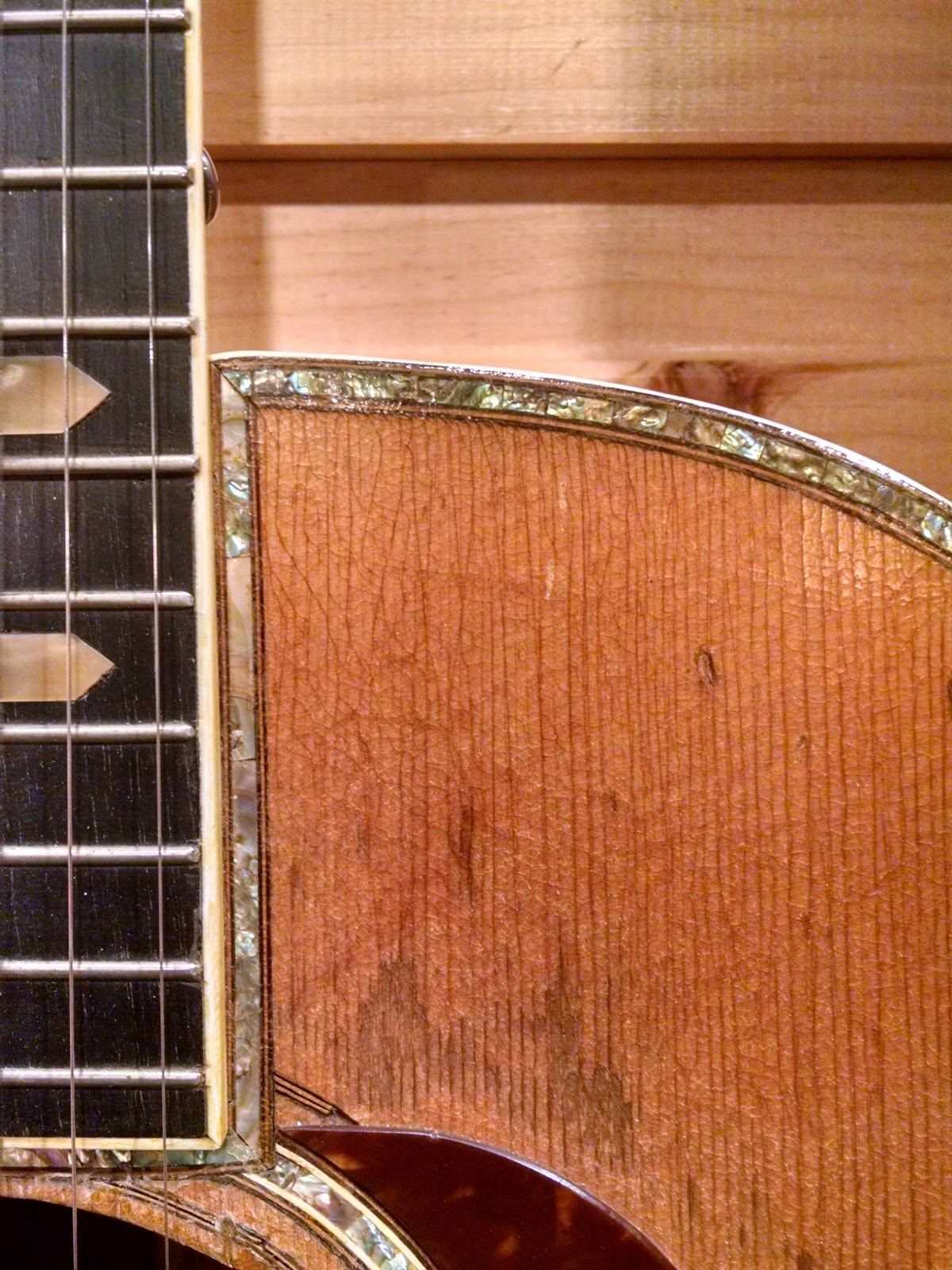
A few months ago I agreed to help my dad with a copy of a Martin D-45 so I could learn how to do the extra pearl work involved in order to make them myself. The way Martin describes their models is with a number following the size (D for dreadnought, 0, 00, 000) corresponding roughly to the amount of ornamentation involved in each model. For example, a 17 has no binding, 18 has simple wood lines next to the binding, 28 has wooden herringbone purfling next to the binding. A 41 style guitar has abalone shell set into a channel winding around the top and in a ring around the sound hole of a guitar. A 42 has that same abalone as a 41 as well as a line surrounding the fingerboard where it overlaps on the top of the guitar. A 45 style guitar has the 42 style top as well as abalone around the back, sides, along the end piece, and where the neck joins the body. And in this case, my dad added two stripes along the backstripe as well. If you want to read more about my experience with binding, you can here

My tiny table saw.
To make this guitar a bit more special than his typical 45, my dad asked me to use real pieces of abalone, not Abalam, the long sheets of veneer layered together which are much easier to work with and also easier to come by. So for hours I sat at the tiny table saw and ran countless abalone pieces through, slicing off pieces a couple of millimeters wide. I made use of the 120 grit sticky-back sandpaper I bought a while back and stuck a piece on a stool next to me. I scrubbed the pieces across the paper, sanding the bottom edge off of each piece so it would more easily fit into the channel I had created by removing the teflon strip that was initially glued next to the binding.

The sides were the most challenging channels to fit abalone into as, if you haven't done the math, the abalone strips are solid and straight, while the side of a guitar is a curved surface. I broke the pieces every eighth inch or so, and then glued the broken piece into place with superglue, then repeated the breaking and gluing as I wound around the guitar. Along with perfect mitre joints where the pearl meets an edge, there are also special joints where the end piece meets the sides. Each piece of abalone is filed into a point then notched into the abalone running along the side. Doesn't sound all that difficult, eh? Well you're wrong. It took a while to make sure the angles of my notches and the pieces they fit into matched exactly to there was no space between the joints.

Look close, I am kind of proud of those joints.


Now, while I was feeling sorry for the state of my fingers, I asked my dad what he remembered about making his first 45 style guitar. It is his number 7, the one he was so proud of and eventually sold to moonshiners for $500 and now has a bullet hole in its back. He told me that he looked at a songbook he borrowed from one of my uncle Max's  coworkers featuring photographs of Red Smiley and Don Reno and Red's D-45.

The fellow who lent my dad the songbook was named Jim Poe. He bought the first 42 my dad made, his #5 guitar, for $50. At that time my dad hadn't seen a 42 or 45 in person, but his cousin claimed the pearl was surrounded on both sides with gold. Thinking back, my dad said he must have thought that because the lacquer had stained the light colored wood pieces that line the abalone making it appear gold with time. In any event, my dad ordered 1 mm thick brass strips from a wood supply company to glue next to the abalone. When it arrived in the mail he realized it was way too thick. He held a grinder between his knees and attempted to grind the brass down to the right thickness, significantly burning his fingers in the process. That guitar it still around, with brass lines flanking its abalone.

At the Galax fiddler's convention shortly after my dad finished that guitar he was able to see a real D-45. He saw George Gruhn walking through the park with it slung over his shoulder and my dad chased him down to look at it. "I thought it was gold around the abalone!" My dad exclaimed. "No, I think that's wo-od." George answered in his signature lilt. Now that he saw one in person, he felt more equipped to make a D-45 of his own.

During a trip to Ray's Hardware in Jefferson, NC my dad discovered a box full of abalone shells. Ray had been trying to sell them for ashtrays, but no one seemed especially interested in them. He sold several to my dad for almost nothing. Daddy then cut the shells into smaller pieces with a hacksaw, then used a file to shape the pieces into flat squares. From there he filed them to the shapes he desired. He then used his pocket knife to whittle the channel for the lines and pearl to fit into the guitar. He glued one set of wooden lines, then glued the pearl in and filed it to fit, then glued the second set of lines. Now we glue everything at once, making space for the pearl with a strip of teflon. He cut his initials out of the extra abalone and whittled a space for it into the headstock veneer. He told me that if you look closely you can see where the pieces are broken because he didn't have a jeweler's saw, or any way to cut the spaces from the middle of a design so everything was cut and pieced together. I looked though, I honestly can't see breaks in that D....


You can more easily see the notches in the abalone of #7.


There's a reason that people flock to Wayne Henderson as being a master at what he does and it has nothing to do with how generous, kind, or patient he is. Those things are just perks. I think what is really incredible is what he was (and still is) able to do with what he has, because for most everyone, there is no way they could figure out how to make a D-45 with completely raw materials and a pocket knife. Especially not one that looks so similar to the factory constructed Martin, and one that sounds, to this day, better than most guitars I have ever heard. No matter how painful or difficult the task, or the number of pieces of abalone I run through the tiny table saw, I will always appreciate that my dad didn't have anyone standing behind him to fix it if he messed up. His experience will always be more difficult than whatever it is I am complaining about. I guess he didn't know it then, but his hard work made it possible for me to realize my day isn't really so bad.

My daddy with his #7 guitar, circa 1967.


Tuesday, January 12, 2016

No Dancing, Pt. 2

The dilapidated barn next door to my dad's house slumps into the earth, the ground in front of it scarred deep by tire tracks of semi trucks and littered with the limp carcasses of Douglas fir trees. The paint hanging from its walls is dingy and chipped, the silo is rusted, and it is used for nothing. Occasionally it houses insecticide to deter pests from interfering in the growth of the rows and rows of Christmas trees planted within the surrounding fields. I remember when it wasn't like that.

When my dad first moved into this house, Kate Tucker's house, I marveled at the proud white barn accented with red trim that had once accompanied this farmhouse. The large barn was used to milk dairy cows, its rows of gleaming stanchions spanning the length of the vast cement floor. At that time in my life, everything looked like a gymnastics apparatus, holding potential in each curve and crook to flip and tumble upon. I don't remember much from Jurassic Park 2, but I do remember a young girl lithely knocking out a bloodthirsty dinosaur by flipping around a pole hanging from the roof of a barn. "Don't you mess with any of that stuff, it is for cows," my dad would always warn after I implored him to explore the old barn with me. So, the dairy cow harness gymnastics stayed safely in my imagination and no bones or equipment was ever broken. Walking up the creaky stairs in the corner, I found myself standing in a hay loft, the chestnut floor still littered with golden straw. The huge square window once used for transferring hay to and from the ground now simply stood open, allowing the warm summer breeze to waft through.

Kate Tucker, the original owner of my dad's house and that barn, might have been the coolest lady who ever lived in Rugby. She and her husband Breece built this house in 1939 and lived here tending their dairy farm until their deaths. They were well respected and probably the wealthiest folks in the county. They worked hard, they were involved in the community, helping their neighbors when they could, and would often donate a significant portion of their money. In a time when women's roles were strictly defined, Kate defied those roles. She almost always wore pants when such a thing was almost unheard of in Rugby, she served as the postmaster for the Rugby post office for a time, and joined her husband in running their dairy farm.

But one day Kate Tucker messed up. She and her husband did not attended church services weekly as most everyone else in Rugby did. They went occasionally though, which seemed to appease most of the community members who took such things very seriously. (Probably everybody except the moonshiners.) While welcoming them when they attended, the church on the corner cast a skeptical eye towards the Tuckers, perhaps expecting they would only sporadically adhere to other church practices as well. A while back I told you that the Rugby Rescue Squad doesn't allow dancing during their gatherings and benefits and the reason is that some church leaders believe dancing is an expression of evil and leads to evil acts. Well, Kate Tucker did not heed that warning.

In that hay loft of the big and bright barn, Kate decided to have a party. She invited her friends who could play music to bring their instruments, and invited anyone who wanted to join her to come. Friends flocked from near and far, kind of along the lines of a Wayne Henderson patented post-festival party. And everyone danced. They danced into the wee hours of the evening.

When the church caught wind that Kate had hosted a barn dance, she was excommunicated from their services. Just for dancing.

Here's the part of the story where suppressing acts of love, kindness and happiness doesn't win in the end. Kate never mentioned it, but she also didn't forget how the church on the corner excluded her for holding a barn dance. Because she had no children, when she passed away, everyone in the community was interested to see where her wealth would be distributed. She bequeathed $300,000 each to three local churches, and only $10,000 to her ex church, specifically to keep up the cemetery in which she was laid next to her husband. Here's another reason I think we would have gotten along: she also loved her three large dogs enough to leave $10,000 to their continued care following her death.

I have quite a few more stories about Kate which I look forward to sharing with you. I used to worry that she haunted this old house, and when my dad would go out to his shop, when it was in a little building about a mile away, I would cower in my room, listening for sounds of a ghost. Now when I am alone here in this house, I am proud to imagine that she is here with me, watching over her house and reminding me to be a strong woman. That it is important to stand up for my beliefs, even if they might not be shared by everyone around me. Be kind, inclusive, and supportive of others.

In closing to this post, I want to apologize (as usual) for the lag time in my posts. If you read this and want to read more, please let me know that! I never know if anyone actually reads what I write so I tend to focus on other tasks (like guitar building) that I am more consistently reminded need my attention. Also, do you enjoy these old stories or would you prefer to know more about the my daily tasks as a luthier? In any event, thank you so much for reading and supporting my work. I hope you had the most amazing holiday season and wish all of you the very best for 2016!


Monday, December 7, 2015

Thankful

There are so many things in my life for which I am incredibly thankful. One of those things is that my dad has bestowed upon me the knowledge and ability to make beautiful hand crafted guitars that people want so badly they are willing to wait several years for me to make them one. I can't believe that is the case, and because of that each instrument is as unique of each person ordering one. My most recent projects were no different, however, there was a bit of a setback that required me to remember how thankful I am for my dad. Even though he caused it.

A week or so ago I finished two guitars, both 000-18s, in record time. I worked on my own, made no mistakes I had to go back and fix, and didn't feel the need to ask my dad for help or review after completing difficult elements.  Not even when fitting the dovetail joint on the neck into the guitar body which is usually a challenge for me as there is no cheating that angle, no option of covering it with an artistic flourish. All in all, the guitars took 14 days, though had my dad not 'helped' they likely would have taken 12 days.

Seven coats of finish had been sprayed on each guitar body and each neck, everything had been buffed out and sported a glossy sheen. All that left to be done before stringing the guitar was frets, which in hindsight, I should have pressed into the fingerboards before I started the finishing process. The reason I didn't was because I wanted to be sure the fingerboard was at the perfect angle after all was said and done so I waited until I was ready to glue in the neck.

My dad and I work on different schedules. I get out to the shop and start working by about 7:30 am, and work until 6 or 7 in the evening. My dad comes in around noon, and works until 3 am. I walked into the shop that morning, bright eyed and bushy tailed, ready to get on the task of fretting the fingerboard. If I finished that by noon, I knew would likely get these two guitars strung up that evening. I walked over to the table where I had left the necks the night before and stood staring at the table for a few minutes. Have you ever had that feeling where you know what you are supposed to be seeing, but the view just doesn't measure up? Like the first time you see a picture of a Platypus. Something's not quite right. Sitting on the granite table was my shiny neck, cut lengthwise down the entire neck, my peghead veneer clamped to an unfinished neck blank.
Sometimes I think of my dad like Santa because occasionally, when I am having a particularly tough time with something, I will give up for the night and go to bed. When I head back out to the shop in the morning the element that had caused me stress will be sitting there finished. This is what I assumed had happened the night before, only this time I was surprised with coal instead of a present. There was a note. It read, "Sorry about your neck. I was trying to be helpful and put in your frets. The fret squeezer pushed into the truss rod [groove]." I read through it a couple of times while I processed this information and though it made me sad that I had a pretty serious setback on my hands, I was mainly concerned that my dad probably felt really bad about breaking my neck. I knew it had to have been my fault if the groove cracked inward like that. After digging the truss rod out of the old neck it turns out the groove was deeper than where the rod sat which surely caused the neck to crack when pressure from the fret squeezer was applied. Sometimes weird things just happen. One thing I have learned from my dad is that there is not much use to get mad, just start a new one. We had a new neck made in record time and I only ended up losing a day or so anyway. The two guitars turned out sounding clean and bright and looked beautiful. It always warms my heart to see my clients love what I make for them and these two guitars did not disappoint.

Vintage lettering like my dad's #52.


White oak back and sides, Carpathian spruce top

Me and Jim
Me and Emory
Finally, I want to take a little side bar and share how thankful I am for all of the teachers I have had in my life. Well, most anyway. The best part is that they have done so much more than teach me their respective subjects, they have taught me lessons of life in general and, indirectly, how to successfully operate a small business. I remember thinking in math class in high school, as I sat in those small salmon colored desks with the table attached for right handed people thinking, "I am never going to need this information right here, let's get to art class." But every time I fit a neck, cut fret grooves, or glue and shave braces I think of my high school math teachers Laura Roarke and Beth Derringer. They championed for me to succeed in math even though I despised most of it and for their unwavering encouragement I am so thankful. I guess my point with this last thought is that while you might not be able to see it while you're in it, be thankful for the people who teach you things, even if they break your guitar neck and make you start over. There's always a positive lesson in there somewhere.