About me

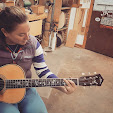
My photo
I began this blog in order to share my experiences learning instrument building from my dad, but along with those stories I look forward to sharing my memories of growing up with two busy, musically inclined parents as well as my current experiences stepping out on my own as a female luthier promoting environmental sustainability in her instruments while working to alter gender stereotypes in a male dominated field. If you'd like to use quotes from this blog for interviews or in your own work, please contact me first! (email is henderson.elizabethj@gmail.com)

Monday, February 26, 2018

Tools

One day, a couple of years ago, I was working in my dad's shop and spied something shiny. As with most things that sparkle, it called to me like his dad's newly awarded, "electric sex" leg lamp called to Ralphie. I zeroed in on the polished metal, scrubbed so thoroughly I could see my face in the bronze cap. This small gold violin plane, when tested, fit perfectly in my hand, effortlessly shaved curls from the edges of my guitar rims snugly wedged into their form. When I asked my dad where this glorious tool had come from he said, "Oh my friend Jerry Tinney in California sent it. I don't remember who made it but I think he said it was made in the US. You can ask him if you want, his card is on a set of wood in the pile over there." (....k thanks I'll get right on that. Digging through the exorbitant stack of backs and sides sent by hopeful clients is definitely an excellent use of my time..) My dad seems to have an uncanny sense of where things are in his overly cluttered, hoarder's paradise of a shop. The card was right where he said it would be, taped to a dusty set of wood wedged in with all the others hoping to be sanded and bent into a Henderson guitar. I called Jerry and told him how much I enjoyed using the plane and wanted to know where I could get one for myself. He told me it was made by a company called Lie-Nielsen, and they make all of their tools in Maine. A few days later, before I was able to order one for myself, a box arrived from Jerry. Inside, enveloped in a roll of packing paper was my very own, even shinier, violin plane.

Since that first rake across those guitar rims, I have found reason to purchase several more tools from Lie-Nielsen, enjoying each as much as that first little plane. The care that is obviously put into each tool they have sent me is obviously not a fluke, so I felt connected to this company, feeling like the people who make these tools understand that when you put your soul into something you make, great joy comes to the people who use it.


If you have read this blog in its entirety you should remember reading about my cousin, Lauren. She and her sister Leah are two of my closest, most important family members, as I think more of them as siblings than whatever amount of removed cousin we actually are. Our summers spent together in Rugby are absolutely among my most cherished memories. So, when Lauren asked me if I wanted to visit her while she was working through a pharmacy school rotation in Portland, Maine this past January, I wasn't so much concerned with blizzards, or freezing temperatures, or winter flight delays. My only question was, "If I come up there, would you be willing to drive me 45 minutes north to a little down named Warren so I can visit this tool company that makes my favorite things for my job?." She agreed, so I booked my flight.


As I knew, heading to Maine in January is a bit of gamble. What if, like when I lived in Vermont, the air freezes my nose hairs upon inhalation? What if it was so dry inside that the skin of my hands would crack, then burn when I applied lotion? Given that the temperatures in North Carolina weren't too far off, and those things were already happing here, and Delta traded me a first class ticket in exchange for some credit card points, I figured I couldn't really lose. I packed my Sorel boots, my fattest down jacket, and a fuzzy hat and off I went to the land of the great white north. Turned out while I was there the weather was kind, only hurting a little bit when the wind whipped against my skin. Surprisingly similar, if not warmer, than Asheville's January.


Old streets. Portland, ME

Lauren and her fiancé Drew went to great effort to share with me the ultimate Maine experience. We went to their favorite fish market, picking oysters from several nearby bays and rivers, we (Drew) boiled lobsters and steamed fresh mussels. We walked the worn cobblestoned streets of Portland, we hiked the snowy trails winding among city neighborhoods, and slid along frozen sidewalks to pick up snacks and rent movies from a nearby, real life DVD rental place. It doubles, or triples if you will, as an ice cream parlor and the local post office.


The air was full of flurries the last full day I was in town. Lauren and I set off to find Warren, and Lie-Nielsen Toolworks. Google suggested we take the freeway at least half of the way there, but we decided to drive up Interstate 1 for the majority of the ride, figuring we were in no rush, and we could see more of Maine's small towns. We drove over lattice girder-braced, one lane bridges, likely built by a handful of locals a few generations past, past Cape Cod type houses painted bright, happy colors, and through town centers offering small quaint shops. One of my all time favorite things to do when I am visiting new places is sit on the rim, quiet and invisible while I watch people simply go about their business. Not the fake, touristy type of a show that you're supposed to see when you visit somewhere, but peek behind the storefront facade and see what is really back there, no matter how simple or 'ugly' it may seem. As we wound our way north, each coastal town we passed was brimming with people just getting by, stopping at their little cheap diner before work to gossip with friends, buying groceries at the one store that offers fresh produce, rushing to make it to work on time or drop off their kids at school. Perhaps it is odd, but show me how people really live in a real town, as mundane as it may seem, I think it is where the beauty in humanity truly lies.


We took a walk outside and found a frozen ocean. We weren't cold at all.
Here's the frozen ocean.


Fish market!! 


I got to be in charge of mussels night. I made two sauces. 
When we pulled up to the red roofed building housing Lie-Nielsen Toolworks, a light snow was falling, but the salted roads were still clear so we decided to go in and ask if we could get a tour. We walked into the wood paneled show room lined with glittering planes, saws and chisels. Jared, a tall, red haired guy in plaid greeted us from behind his desk. He said he would be glad to give is a tour of the company, so off we went through the factory door.

I learned that Tom Lie-Nielsen started this company because he wanted to ensure that woodworkers were provided with the option of high end, US made tools back when there were few options available for such things. He worked for the tool company Garret Wade in the early 80s, but when they stopped making their #95 bronze edge block plane, Tom took it upon himself to try to make one of his own, similar in design to the original Stanley planes which he felt needed little adjustment to the classic, ergonomic design, but with the highest attention to quality and aesthetic. The company began as a one room operation so to speak, just making the one type of plane, but eventually expanded to hone and design many types of 'old school' planes, chisels, hand saws, and other hand tools.


Jared handed us a couple of hardhats and some protective eye ware. While Lauren's looked similar to those aerodynamic cyclist sunglasses making her look like she might set a speed record for a factory tour, in my case it meant a swath of oversized plexiglass clamped to my face to accommodate my glasses, which are necessary were I in the mood to see things. I distinctly remember my grandfather sporting the yellow-tinted version for when he drove his Lincoln Towncar twice a week to the country club. Once properly attired, we ventured with Jared into the bustling factory.


The first room we were led into was the saw making room. There was only one man in there, and he stood at his workbench painstakingly inspecting the saw blades before attaching their curly maple handles.The saw blades were being run through a clunky looking but surprisingly smooth working machines using simple belt technology to cut perfect notches into the saw blades. Jared proudly explained to us that those machines were manufactured in the 1940s and, since irreplaceable, were handled with such care they rarely needed servicing except for regular checkups. They reminded me of my dad's old heavy Black and Decker router, the first tool he bought with the $500 he was paid by the moonshiner for his #7 D45. That thing has had bits, switches and bearings replaced, but is still one of the most cherished tools in my dad's shop.

It was amazing to see the attention to detail as we wound our way through the rooms of folks working on various steps of the tool's progress. We were shuffled through the plane assembly and inspection room where we were told each plane comes with a blade hand sharpened by an employee before it is shipped out so as to ensure that each blade is able to hold an edge and demonstrate that each tool has been inspected to the fullest. As we stood watching guys run hunks of raw metal through various machines, Jared explained that while the CNC machines positioned in the center of the room shaped things perfectly, if someone were to mess up the programming, multiple products would be ruined, whereas these human led machines produce fewer mistakes since a person is at the helm of the ship allowing for adjustments if necessary after just one tool. As we were watching the progress, an apron clad man with a white beard approached us and handed Jared the base of a block plane, pointing to a tiny blemish in the metal barely the size of a pinhead. I had to squint through my plexiglass to see it. "Yep, that'll go back to be melted down and recast," Jared told us. "We would rather take the time and effort to redo something like that, even though it has nothing to do with the function of the tool rather than sell it as a second because we don't want anything less than perfect on the market, even if it is a secondary market. It came from here so we want nothing less than the most perfect tools out there with our name on them"


Sharpening.
One of my favorite things that I observed during the tour was the care that each person took on their specific job. It reminded me so much of Cane Creek Cycling Components, the company where Nick works as a purchasing manager. Lie-Nielsen, like Cane Creek, employs local folks who show up and work to do a good job, not only young. transplanted whippersnappers who want to make bike parts in Asheville or the quintessential old man woodworkers (no offense) who want a good discount. It heartens me that everyone who works here might not be the utmost expert on tool handling and woodworking. No matter their background, these folks obviously take great pride in their respective positions within the company, and choose to work there not just for the woodworking perks but because it is a great company in general.

I am extremely thankful to for having had the opportunity to visit this great company and see how the tools I find so beautiful are in fact, beautifully and thoughtfully made as well. While observing their process, I couldn't help but feel a bit of a kindred spirit. Knowing that they put as much time and effort into making something that allows me to do the same with my work is the best reason I can think of to support this awesome company. I think of my dad's friend Jerry each time I use one of my tools from Lie-Nielsen and am extremely thankful for each one I have. My job is never just about making a guitar, and Tom Lie-Nielsen's isn't just about making a block plane.


Polished and awaiting a blade before shipping.


Shaved bronze to be remelted to make more things!


All the beautiful chisels. 


Monday, January 29, 2018

New Year

First, let me tell you that I am super excited to be back from a self inflicted hiatus. Sharing with you is extremely important to me but I began to feel a bit uncomfortable knowing I had inadvertently provided countless quotes that can be used out of context for interviews and for other's projects without my knowledge of what is being used and how. In an attempt to regain a bit of control I stopped providing them. It doesn't bother me that the stories I share here are being used, but not knowing what sentence will be taken, for what purpose, and in what context has left me feeling a bit off kilter. Now that I have taken a step back, regrouped, and added a little caveat to the top of my blog I feel much better. So let's begin...again.

With a snow storm looming this evening and a high of 24 degrees forecast for tomorrow, I haven't been able to think of much more than how uncomfortably cold I am. This winter has been rough down here in the southeast, but before I get too frustrated with my situation; well insulated house, money to afford heat, down jackets, heavy Sorel boots and thick gloves, I want to remind my self of stories told by dad and Granny of Rugby winters past when temperatures were colder, for longer periods of time, and when the snow piled much higher over these quiet mountains.

When my grandfather, Walter, married my Granny around 1929, during the height of the depression, they lived on a small farm on Quillen Ridge, about a mile and a half from where I currently sit on my dad's couch. Around here the depression had less impact as nobody really had anything to begin with so the crash of the stock market didn't make a huge dent in the local poverty levels. Gardens and farms supplied food, clothes were made from feed sacks, goods and labor were often traded but there were still some costs to keeping a farm running that required money.  Because work on their little farm didn't last through the winter, Walter sought other means to supplement the family income. Since he didn't own a car, each day Walter set out walking to downtown Rugby, often wading through snow that reached his belt buckle. One of my favorite running routes around here is up Quillen Ridge road but it isn't easy. The steep gravel road twists through fenced fields holding grazing cattle, nestled among thick stands of trees before leveling off a bit to reveal a view of the rolling blue hills of North Carolina. It is beautiful but definitely a challenge walking up or down the hill.

Harper on Quilled Ridge road in the snow. 
Once arriving at the general store marking the heart of downtown Rugby, Walter hitched a ride on the back of a state owned dump truck with a few other local men. They shivered in the wind until the truck came to a halt at the end of the road. Wielding long heavy picks a la Oh Brother Where Art Thou, minus the striped outfits, the men lined up and picked out and flattened the earth, making way for more road. The men were paid ten cents per hour for their efforts and worked until their the fingers of their thin gloves were worn through. After about twelve hours working in the cold, Walter walked back up Quillen Ridge road toward home.

View from Quillen Ridge

My dad told me that eventually Granny and Walter bought the house and 100+ acres I know as Granny's house from her grandmother Lissy for $5000. He said that was so much money to them they never thought they'd be able to pay it off. Many years later Walter saved enough to buy a brand new forest green 1956 Chevrolet pick up truck and used it for another method to earn extra money for their mortgage.

The roads were still pretty rough in the 50s so the local school sought someone to pick up the kids who lived so far back in the woods the school bus couldn't drive on the steep, uneven, and narrow dirt roads. Walter made a cover for the bed of his truck and slid two sets of long seats into the back for kids to sit. Every day during the school year he drove his route, picking up kids, taking them to school, then dropping them back off home at the end of the school day. My dad said he did this every day for all the years he was in school and even after that.

One winter morning, after about a foot of snow had fallen, Walter asked my dad if he wanted to accompany him on his route. My dad had only gone with him a few times, as he lived close enough to school that he could walk but agreed that morning. Leaving the house with only low slippers and a light coat my dad joined Walter in the cab of the truck. The bed of the truck where the seats were installed wasn't heated so in the winter Walter allowed the smallest children to sit in the heated cab and the older kids sat bundled in the back. Often there would be five or six children packed in the seat next to him bouncing over the green vinyl seats as they made their way toward school. As they ascended York Ridge, where the road is particularly windy and steep, the truck wheels spun in the slick deep snow instead of propelling the truck full of children closer to school. Walter wouldn't leave the kids unattended so he sent my dad in his little slippers to the nearest neighbor he knew who had a tractor. My dad slipped and trudged about a mile up the ridge to fetch Gail Cox and his two cylinder John Deere tractor that made a funny noise. Despite the cold, my dad was thrilled to hitch a ride on the three point hitch on the back of the tractor, the wind ripping through his thin jacket and burning his red cheeks. Once pulled free of the troublesome spot in the road Walter drove the remainder of his route to the school.

So while I work to keep my instruments hydrated and my hands warm, I find it important to take a few minutes to think of and be thankful for the sacrifices my grandfather made for his family every day. His ingenuity in building the first camper my dad had ever heard tell of, his commitment to providing for his family and community no matter the weather is inspiring. I hope you're staying warm too, but just in case, here are a few pictures of my current builds to distract you from the freezing temperatures outside.


Walnut 000 rims 
Pieces


Fingerboard before the pearl
42 and 45 style tenor ukes in progress

Perhaps my favorite set of koa ever. Thanks to my friend Paul from Kauai! 
Two tenor ukuleles waiting to dry enough to be buffed out and strung up!


Friday, April 14, 2017

Egg Hunt

Easter is one of my favorite holidays. I am not entirely sure why, perhaps because the weather is promoting hope that it is going to be, and stay, warm soon. Maybe just because I don't have to share my birthday with the holiday like I do Christmas. But I just love it.

I have so many memories of my Granny rolling around in my head but some of the most distinct ones are during Easter festivities. I remember a shiny glazed ham, biscuits, gravy, birds nests constructed of green jello topped with whipped cream, shaved coconut, and three jelly beans. (If you thought there was something a little off about my dad before, here's a clincher: he always got three black jelly beans in his nest. He wanted them...) Of course my (and my dad's) absolute favorite food, my Granny's potato salad, would be sitting quietly in a nondescript white plastic bowl within arms reach of my plate. For this holiday it was always a bit dressed up, topped with slices of a sacrificed Easter egg and green onion. Most of all, I remember the egg hunt that was orchestrated after dinner.

The reason the egg hunt was so memorable to me is because all of the adults were looking forward to it as well. If you know my dad at all, you know his favorite things are Martin guitars, old guitars, guns, and guitars. In that order. So when I was young it was so exciting to see him truly happy to participate in something that didn't require six strings or the use of a pocket knife. My relatives would all excitedly join the hunt, even my Aunt Shirleen who I always recall being quiet and reserved during family dinners.

We would divide ourselves into teams and fill baskets with our colored eggs. Granny always had an egg dyeing kit that she saved until I arrived for the weekend. She would grandly present the brightly colored cardboard box of dye to me like it was a rare treasure. She always had a great ability to make mundane things seem special. After the ceremony, we would go about setting up all the accouterment that dwelled inside the little box, placing everything on top of newspaper lining her large round oak table, the color of which always reminded me of thick blackstrap molasses. One by one we would drop our eggs in the vinegar and food coloring solution, carefully selecting the perfect number of dips to make the brightest and most beautiful eggs. 'See if you can get them to stand up straight on these little stands without touching the eggs or dropping them on the table,' she challenged. Careful not to smudge the dye, I would lift the eggs from their colored bath with a spoon and slowly transfer the colored eggs to their drying racks. She always made a show of being impressed with my performance. Perhaps she's the reason I have such steady hands today. (Truly, I have never understood why that game Operation is billed as a challenge.)

The team assigned to hide eggs first would skip out the front door. I was instructed to stay away from the windows. I would wait with members of my team, anxiously tracing the blue flowers woven into the couch with my fingers. Finally we were allowed to venture into the yard to find the hidden eggs. We would find them tucked behind fence posts, shoved up drain pipes, perched precariously in the lattice fencing that ran beneath the porch, in trees. I remember once finding a bright blue egg nestled in a stack of twigs and grass and wondered if that was ours or if I was stealing someone's baby. (My dad was so proud of himself for hiding that egg in there.) The excitement was equal watching people find the eggs I had hidden for them.

When I asked my dad and Shirleen if they remembered anything from their Easters growing up, their responses were overwhelmingly familiar. Shirleen told me that she always looked forward to getting a new Easter dress that Granny would make for her. On Easter she would don her new dress and she would walk up the road to her Granny Ollie's house, where her dyed Easter eggs would be waiting for her. Granny Ollie didn't have a PAAS coloring kit, but she would gather eggs from the hen house and separate the white ones out and dye them with golden strips of onion peel she had saved. I asked, "didn't that just made them the same color as the brown eggs she didn't want to use?" Shirleen replied, "Sort of, but they were brighter, like the color of copper. They were special. I couldn't wait to get my eggs from my Granny." They would then have family dinner and gather all of their cousins at Granny's house for the big egg hunt. "That was sort of a big deal because we got to visit with all of our cousins. Other holidays was usually just us, but Easter Aunt Wanda, my cousin Imogene and all our other cousins would come over and hunt eggs with us."

My dad told me that he and Granny would color their eggs with a store bought kit that she would always make a show of bringing out and setting up. They would color their eggs, and mark them with crayon or wax before they dyed them so some of the dye wouldn't stick.  The marked one was the lucky egg. He told me if you found the marked egg you won a dime. There were prizes for the most eggs found as well. After talking with him about his egg hunts growing up and remembering ours together the said, "We are all old enough now we could probably just hide our own eggs."

I didn't realize until I spoke with my dad and Shirleen that my endearment for Easter is deeper seated than I had originally thought. It goes beyond the egg hunt and the potato salad. It matters to me that I was given the same simple but special traditions they experienced growing up; same house, many of the same characters, just time moved a little bit. This year I am hosting Easter festivities at my new house in Asheville. I know it won't be the same, I might not have my Granny to dye eggs with me, but I sure have my memories, my love for her and my family, and a great hope to pass on our traditions to future generations. And I have Granny's potato salad recipe.

I wish all of you the happiest of Easters, I hope your day is filled with hope, love, kindness, family, and good eating. To help you out with the last thing, here is the recipe for Sylvia's German Potato Salad.

6 medium Idaho baking potatoes
2 Tbs butter
Splash of milk
1/2 Cup sugar (Shirleen uses 1/3 Cup)
1/3 Cup apple cider vinegar
2 Tbs mustard
1/2 Cup finely diced white onion
Sliced easter egg and chives/green onion for garnish

Peel and cube the potatoes, bringing them to a boil in a pot of well salted water. When the potatoes are fork tender-maybe 20 minutes, pour off the majority of the water, saving maybe 1/4 cup or so. Mash* the potatoes, add butter, milk, and salt "until potatoes are good" ("What?" I asked Shirleen, who was reading the recipe to me. "That's what she wrote. Until they taste good." She replied. Hm, ok. That's the kind of thing I would write in a recipe...)
Add the sugar, vinegar, and mustard and mix until well
blended. Fold in the onion. Top with hard boiled Easter egg and chives/green onion if desired.

*Note: We like the potatoes totally mashed and smooth but you're welcome to try it however you prefer your mashed potatoes.


Sunday, March 26, 2017

Hawaii

A while ago I got an email from a fellow named Paul. The title of the email was 'Aloha'. In the note he told me he was a surgeon-turned-ukulele-builder in Hawaii and had recently heard a story in NPR about me and my dad. He said the reason the story struck his attention is because he has distant relatives from the Rugby area and thought it interesting a guitar builder lives there in that tiny place. He decided to email after checking out my ukuleles and enjoying the inlay work I do. The thing I remember most about that first email is that he told me that he had recently retired from being the sole surgeon in his hospital so he took up ukulele building now that it is economically acceptable to lose a finger.

After chatting for many months, trading sets of koa for Red spruce, and learning about each others build process, he asked if I would be interested in coming to Hawaii to teach him and several other small builders my inlay techniques. At first I was thinking that has to be some sort of trick question, right? I get to go to Hawaii. To show people how to do my favorite thing. In February, arguably the worst month of the year. (Sorry Valentine's day and Nick's birthday, you don't redeem that dreary cold month in my book.) After it was confirmed he was not joking, we set up the dates and I booked a flight for myself and for Nick. (Because of the birthday.)

I love airports. To me they signify a gateway to possibility, adventure, and unknown. Everyone is going somewhere, has a purpose, and a reason for being there. I have spent countless hours in these expansive bustling buildings, usually alone, but never feeling lonely. My favorite pastime is observing the folks whizzing around me, wondering where they live, where they are going and who they are going to meet at the opposite gate. I will often make up backstories based on clues gleaned from their luggage, attire, and demeanor. Once I saw a woman carrying a shiny gold trophy through the terminal. It stood several feet high when she sat it on the floor. She didn't look particularly athletic, wearing dress pants with footwear inappropriate for comfortable travel and that was the only thing she had with her-no other luggage or sports bags so I didn't suspect she won an athletic event. I like to imagine it was awarded for an adult spelling bee and she won for an awesome word, perhaps something along the likes of 'callipygian'. (Feel free to look that one up.)

The flights, Asheville to Lihue, Kauai, via Atlanta and Los Angeles, weren't bad. Not too long, no excessive turbulence, and only one obnoxious seat mate who was overly excited about the cruise he was going on to Mexico with his Corvette club. Nick took the brunt of that one as I busied myself with being super interested in watching Jack Black drive his Waggoneer away from monsters of his own creating in Goosebumps. It was amazing. (It had to be.)

Orange juice from the yard!! 
Paul greeted us at the airport with leis and a hugs. He and his wife Syd were two of the most thoughtful hosts I have ever encountered. They planned meals for each day of our visit, along with fresh squeezed orange juice from trees in their yard, provided ideas for things to do during the days I wasn't teaching, and sent us off each morning in their silver Tacoma with a hand drawn map to points of interest and a huge bag of snacks. My main takeaway from that is that I know they are excellent parents and that they miss their daughter who now lives in Wisconsin. (I know, what!?) The first day we went on a hike, Paul insisted on providing our lunch and stopped into a market at the foot of the hill from his house. "What is that?" I asked, as he handed us little bundles wrapped in saranwrap, noting it was a mound of rice wrapped in nori with a meat-ish looking slab in the middle. I love sushi rolls, but I had never seen any as big as a sandwich. He told me it was called musubi and he would tell me what it was after I had eaten it. Hm. Something tells me he and my dad would be best friends...
View at Paul's house
Orange tree!!


Breakfast-pineapple, Portuguese sausage, french toast, and tiny but super sweet bananas
Sunset dinner on the beach.

After a sunny hike along sea cliffs ending at Shipwreck beach, that musubi tasted amazing. Kind of like a salty pork sandwich sushi roll. When we got back to his house that night I told Paul I really liked the musubi and asked what it was. "It's Spam!!" Then he cackled, like literally cackled, for a full minute. Nick got musubi every day after that stating it is perfect hiking food.

Tuesday morning I attended a rehearsal for Paul's ukulele club. It was pretty much like the ones I have attended in North Carolina, except they all strummed traditional Hawaiian tunes instead of The Beatles and Over the Rainbow. Trying to follow along was difficult because to me all the Hawaiian words sounded the same, just slightly different variations of a vowel. The woman sitting next to me sang the songs as we all strummed our ukuleles. Perhaps in her sixties, she looked wise and thoughtful and kind. She wore a smart boater hat with a black ribbon perched on her head. Paul told me she is never without a hat. Her voice was rich and low and commanded attention. Those vowels sounded so beautiful coming from her. During several songs, Rose, one of the club members, did a hula dance. That was mesmerizing as well. Her relaxed flowing movements matched the music so well that they and the notes didn't seem like two separate things but a perfectly wrapped package presented with a long satin ribbon tied to it, each element just a bit lacking without the other.

Paul didn't seem phased that I had never taught an inlay class before. But standing before nine adults, all older than me and all having experience in woodworking and instrument building, I wondered if I could actually teach them anything. I thought back to my dad's advice, "Just go tell them what you do and how you do it. That's all you can do. You don't have to tell them about anything you don't know." He said that to me on the phone as I was hyperventilating outside the hotel before my talk at the Fretboard Summit in San Diego. Like now, I was going to go speak to a group of people who all had more experience than I did and were all older than I am. But I did what he said and it went just fine. (More on that trip later) The situation I was facing now seemed somehow different than that experience though. I have such a strong passion for inlay and know that I can do it well that I felt much more comfortable in this little cramped shop on Kauai than I did sitting in that chilly room in San Diego. I know that the inlay I do is sound and that I have gleaned enough experiences along the way to be able to show people my process.

Don't get me wrong, I have taught people things before. I have a minor in Outdoor Leadership from my undergraduate alma mater, which essentially means if you want to go do something outside, I can show you how to not die. Through that program and some amazing teachers I learned outdoor skills, and then learned how to teach other people to set safe anchors for rock climbing, how to belay, how to guide a canoe, how to kayak, how to tie useful knots, how to read tides and how to dress appropriately for an outdoor activity. I remember once when I was the Teacher's Assistant for one of the outdoor PE classes and was questioning my ability, my favorite teacher and mentor Tommy Holden asked me, "Ok, so if I weren't here or something happened to me, could you get everyone back to the van safely? How would you do that?" I thought about it, formed a plan in my mind and knew that I could. It might not be pretty, but I knew it was a possible task for my skill set. I kept that thought with me for all of my TA and trip leading duties, as I guided tourists in kayaks across Fritz Cove in Juneau, AK, and when I taught elementary school kids environmental education in Vermont.

Teaching the inlay class I thought how would Tommy show these people this skill? I thought back to one of the very first lessons he taught my freshman year climbing class. Sitting in a circle on the blue spongy floor of the gymnastics gym (which happened to be in the same room as the climbing wall) he showed us how to tie a bowline knot with a little narrative about a bunny and a tree. The bunny (aka the rope end) comes out of his hole (a loop in the rope), looks all around his tree the rope) and then dives back in his hole. And you have a bowline. To teach my students how to make a turn with the saw blade, I told them the saw had to march in place. I know the task is different, but the goal is the same and visual narratives seem to help drive home concepts. I thought of Tommy's bowline lesson and all the ones following that one, and thought, 'Alright, I can teach this like Tommy does." I knew he would make sure everyone felt like they were successful, praise their effort before offering a helpful critique, and always be clear and positive when presenting information. So I did that. And everyone had fun and everyone cut out an amazing design, all slightly different from the inlay I showed them. They all brought their own ideas and personality to the project which made me feel successful too. I had the best time those two days, and feel as though I made lasting friendships as well as showing people a skill and making them feel as though they can do something they couldn't before. I doubt I made as strong an impression on my students as my teacher Tommy did on my life, but if they get a tenth of the confidence and knowledge he bestowed upon me, I am grateful.

My class!  

Two of my awesome students brought me a lei! 

What we mad

Paul sent me home with a tan (ok a sunburn), a fascination for feral roosters, a taste for Spam, a 100 year old plank of a kona coffee tree, and most importantly confidence that I am proficient enough at what I do that I can show other people how to do it. Nick asked if he could help make the kona coffee ukulele. I was surprised he wanted to learn, but am so excited that I get to teach him how to make a ukulele. We have been working on it each weekend I am home and he is doing an excellent job. We successfully made it through a week of canoeing in Florida together, which Tommy calls divorce boats, so I bet we can make it through building a ukulele together too.


A shop in Kalaheo that only uses koa...

Shave ice is serious in Hawaii. That wasn't the large.

Hiking to a waterfall! 

My rooster friend Monty. On top of an 800ft waterfall. He left once he saw I didn't have food for him.


Thursday, March 2, 2017

Setting Up Shop

The past few months for me have consisted of a whirlwind of travel, building a house, making instruments in order to purchase said house, moving, and setting up a shop of my own in the basement. Turns out executing such tasks leaves little time for writing you stories, but I have so many saved up and I can't wait to tell you so get excited. I will begin with building a house and a shop because that has usurped the majority of my time and energy since August. 

Watching the progress of the house was somewhat surreal. I couldn't believe it was my space, or perhaps just didn't want to believe it until it was actually ours. Actively searching since last March, finding a house with shop space in Asheville was proving difficult, and having to obtain the permits to build one into an older house even more frustrating. The more I learned about the process and what would have to be done, the more I felt like one of those dogs running through an agility course, though not a lithe Border Collie, but perhaps a pudgy, aging dachshund that can't quite jump high enough to make it through the hoop or all the way up the see-saw. When it seemed just about hopeless, my dad called one muggy June evening and told me he had spoken with a guy who came into the shop who just happened to be building houses in one of my favorite neighborhoods in Asheville. He has been after my dad for a guitar for a while so in exchange for one, he said he would happily work with me to build a house that had everything I needed, without having to beat out a myriad of other people making higher and higher offers as we had previously been doing. (Sitting in my lovely, finished house now, I am still wondering if I am dreaming.)

After several months of picking paint colors, floors, tiles and countertops the house was about ready to move into. Each time I visited the house, I would walk down to the basement to see the shop space. Unlike the rest of the house, which would have a new element each time, the shop was always the same. Just a cement room with double doors out the back and two big bright windows on the adjacent walls. It didn't matter, it was my space and unlike any of the other options I had looked at, I would be starting out with a suitable number of electrical outlets (36!) and almost excessive lighting. 

On my birthday, the day before we closed on the house, I took my usual tour, walking upstairs, admiring the backsplash I chose in the kitchen, then walking down to the shop. When I opened the door, instead of an empty cement room, I found beautiful sturdy cabinets and a built in counter, a work bench and several machines standing at attention against the walls. While always wishing for one, I have never gotten a surprise gift on my birthday and I was a bit overwhelmed with how excited seeing a bunch of shop tools made me. My dad's friend Chris and his builder Chuck had spent the previous day building it out for me totally unbeknownst to me.


Standing in my new shop on my birthday.
 It turns out setting up a shop isn't the easiest thing to do. The small number of tools I do have, I placed in the same drawers my dad has his in so I can feel a little more at home. Every time I reach for a tool, I have to think, oh wait, I don't have those clamps, or I don't have enough of those clamps. They are three hours away in their drawer at my dad's shop. Then I have to go take a trip Home Depot and see if I can find something similar enough to my dad's to work. Now I know I am pretty dang lucky to have my dad, his friend Don, Chuck and Chris, and everyone else who wants me to succeed standing behind me in my corner helping me get everything set up. My dad didn't have that when he first started building his guitars.

The building that served as my dad's first shop sits on a little flat spot across the drive from my Granny's house. During my summers staying at her house, other than picking raspberries from the prickly briars that climbed along the outside walls of the shop, I have no memories that prominently feature that building. By that time my dad had moved production of his guitars to what I refer to as the 'old shop', the building next to the Rugby Rescue Squad that he rented from Vivian Osborne for $25/month. Since I didn't know much about that first building at Granny's, I called my dad and asked. 

My favorite conversations with Wayne Henderson are ones where he tells me a story. I feel like most other conversations are a notch less comfortable for him, but when he is telling me about our family, his experiences building instruments, or that time he pulled a prank on his substitute, Jimmy, he happily chatters on until I remind him that brace he glued down earlier is probably dry by now.

He told me he built that building himself, with his dad serving as his only knowledgeable reference and helper. "I bought some lumber from a saw mill up on White Top. It cost me $75. I believe that was the first time I had ever written a check," he told me. He said at that time there weren't any building codes or anything so he just built a 16x20" room in the same manner as one would construct a barn, a task which everyone in the area had experience, and installed a bunch of shelves along the walls. He told me he had a few tools gathered, and his dad had given him some spool clamps which he set on the shelves. "Even with those shelves I soon found out that a 16x20" room was not quite big enough." 

When the moonshiner paid him for his seventh guitar, the D-45 that now sports a bullet hole, my dad  took the $500 and bought a Shopsmith, a Black & Decker trimmer that we now refer to as 'the router', a bunch of clamps, and some other small tools.  That router is still in production, though I worry perhaps it shouldn't be as the cord has been repeatedly mended with electrical tape, but still occasionally shoots sparks across the shop floor as it scoots along the edge of a guitar back. I understand his reluctance to retire it though as I have repeatedly tried and failed to find a suitable replacement from the selection of new and fancy power tools currently offered at hardware stores. I also know the clamps to which he is referring, as I use them often, even rifling through the drawer to be sure I use those specific ones. I prefer them immensely to the newer ones intermixed in that drawer and missed them very much as I was gluing braces to a ukulele top in my own shop. I had to take my daily trip to the Home Depot for some similar ones, but again, they don't quite measure up. Most of the tasks the Shopsmith was responsible for have been replaced with other tools, but it still sits retiring proudly in the corner enjoying a bit less use in its old age.

I haven't had many visitors to my shop yet, but I look forward to getting some as, while it can be a bit irksome having people standing in the way, it is equally fun to have people stop by and show interest in what you're doing. My dad told me about some of his first loafers. A typical fixture was his Uncle Cone. I was very young when Uncle Cone died, but I have a vague recollection of an extremely wrinkled man who would sit statue-like by the wood stove at Osborne's store when we stopped in to get the occasional scratch-off lottery ticket. My dad would always say in a voice loud enough for Cone to hear, so I knew he didn't mean it, "Now stay away from him, he's crazy." My dad said Uncle Cone would come to his shop periodically trying to convince my dad to drive him to the hospital because he would "take drinking spells that would almost kill him" so he had to go detox at the hospital. He would quit drinking for a couple of weeks then retox again. Apparently his drinking habits had upset the rest of his family members and my dad was the only one who would agree to drive him down to Independence. 

One day though Uncle Cone was out of luck. A man named John, whom my dad had met while working at George Gruhn's shop in Nashville came walking up the driveway. He had been in the market for a D-45 and my dad had told John that he knew Red Smiley's D-45 was for sale for $4000 in Roanoke. "I think he was scared to drive across the creek or something, because I didn't hear him drive up or see a car, he just came walking up the driveway holding that guitar," my dad said. "Uncle Cone was sitting by the door still drunk. He looked right at that guy like he knew him and said, 'Lord I wouldn'ta thoughta you for $5.' I don't know what John thought of that but he probably thought we were all crazy. I told Uncle Cone I couldn't drive him to the hospital that day, I had to look at Red Smiley's D-45." 

I asked if there were any other exciting stories to come out of that first shop and he told me one more. He said I couldn't print it, but I am going to tell you about it anyway because I laughed until my eyes were streaming tears. Here is what he said: "Well, Uncle Cone's son, my cousin Dick, was over with my good friend Ronnie Testerman. Ronnie was sitting cocked back in a chair and had a cigarette lighter out playing with it. Next thing I know there was a blue flame come up higher than his head and almost set the place on fire. I think what he was trying to do was cover up a fart by using that lighter like a match, but instead it plain blew up. I have heard of people doing that, but had never seen it with my own eyes. I swear that's what happened. I honestly thought it was going to burn my shop down." If you know my dad, fart jokes are just about his favorite thing, only second to seeing a prewar D-45 in person. 

My dad in his first shop circa 1972. Photo credit: David Lewis

I haven't had too much excitement in my shop yet, aside from getting a guitar stuck on my arm for about twenty minutes and worrying I would have to go to the hospital with a guitar stuck on my arm, but that is a story for another time. Each day I have to figure out a new problem, or how to make a form, or clamp work without the help of my dad and all of the tools hanging at the ready in his shop. I am thankful I have so many folks who believe in my ability enough to be willing to help me make an awesome space to build my instruments. 

I noticed the other day that my dad had a new set of fret files hanging on the hook where the familiar red, yellow, and orange handled ones have been stored for years. These new ones all have the same colored handles, and I don't like the feel of them as much as the original ones. When I commented on that, he said, "Yeah, I don't much like them either, but I am trying to get used to them so you can take the old ones." Seeing as he still uses a router that spits sparks while perfectly cutting the groove for binding, I know that there is a greater honor in being gifted the fret files we know and love rather than just getting the new ones. While I am so thankful to have a space that is mine, new and unfamiliar now, it is that much more important to me that he will always be there in my fret files, clamps, patterns, and forms. 


Here's to new adventures.